Search for what a basement floor coating costs and you get a per-square-foot range with nothing behind it.
Here's a real one. In October 2026 we coated a 1,600 square foot unfinished basement in Woodridge, Illinois. It came to $7,500 and went in in one day. Below is what was on the job, what we did, why the price per foot landed where it did, and how it compares with another basement we coated the same month.
Key Takeaways
- Final price: $7,500 for 1,600 sq ft, which works out to about $4.69 per square foot.
- That's below our typical $5.50 to $7 per square foot for polyurea flake. It was a big floor with nothing to repair and no add-ons on the job list except the custom flake.
- System: polyurea base coat, OPAL flake broadcast to rejection, clear polyaspartic topcoat.
- Installed in one day. Walkable after about 12 hours, ready for full use after about 48.
- New concrete still got diamond ground. A clean slab doesn't mean you can skip prep.
- Same month, different floor: a 1,300 sq ft Lockport basement with an existing coating ran about $5.17 per square foot and took two days.
The Short Answer
A 1,600 sq ft polyurea flake basement floor cost $7,500 on our Woodridge job, about $4.69 per square foot, installed in one day. Our polyurea flake floors typically run about $5.50 to $7 per square foot, so treat this one as the low end: a large, new slab with no cracks and no old coating. Repairs, an old coating or a moisture problem will push a basement higher. You can see our full price ranges by size on our basement floor coatings page.
The Case File: Woodridge, IL, October 2026
| Job detail | This floor |
|---|---|
| Space | Unfinished basement |
| Floor size | 1,600 sq ft |
| Concrete going in | New, no cracks, no existing coating |
| System | Polyurea, flake, polyaspartic |
| Flake | OPAL, a custom color |
| Install time | 1 day |
| Walkable / full use | About 12 hours / about 48 hours |
| Total | $7,500 (about $4.69 per sq ft) |
The floor
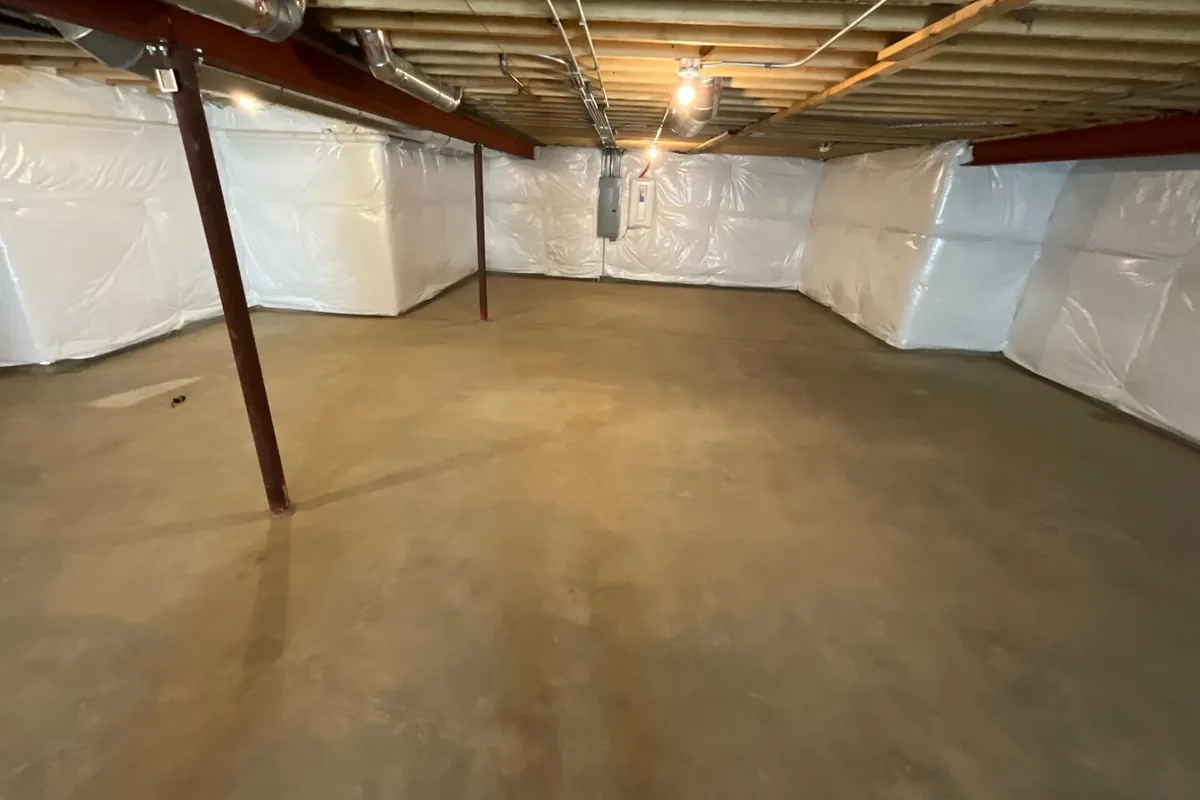
This is the basement before we started: open joists, exposed ductwork, white insulation blankets on the walls and steel columns standing in the middle of the floor. The concrete looks blotchy in the photo, but it was new, with no cracks and no old coating. That's about as good a starting point as a floor gets. Nothing to strip and nothing to fix.
The work: step by step
- Clean off the surface. New slabs often have a smooth, slick top layer. We took off the surface sheen and any contaminants first.
- Diamond grind the whole floor. We diamond grind instead of acid etching because it leaves an even profile across the whole slab. That slightly rough texture is what the base coat grips. Skip it and a coating can end up sitting on the concrete rather than bonding to it.
- Base coat. A polyurea base coat went down across the full 1,600 square feet.
- Flake. While the base was wet, we broadcast the custom OPAL flake to rejection, adding flake until the base couldn't hold any more. If OPAL isn't your color, we also offer 29 standard flake blends.
- Scrape and vacuum. Once it set, the loose flake came off so the surface was even.
- Topcoat. A clear polyaspartic topcoat locked the flake in and gave the floor its wear layer. You can read what each layer does in how a coating system works.
- Clean up. One day from start to finish. Walkable after about 12 hours, ready for full use after about 48.
The result
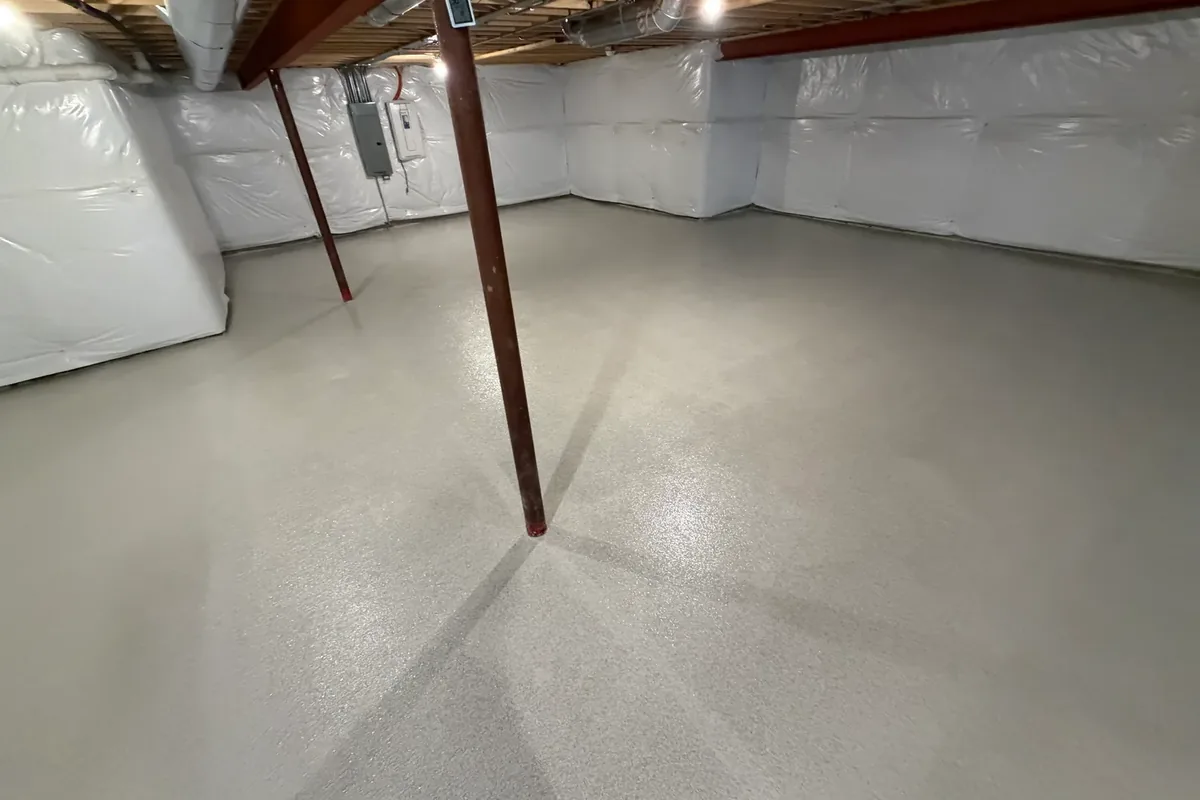
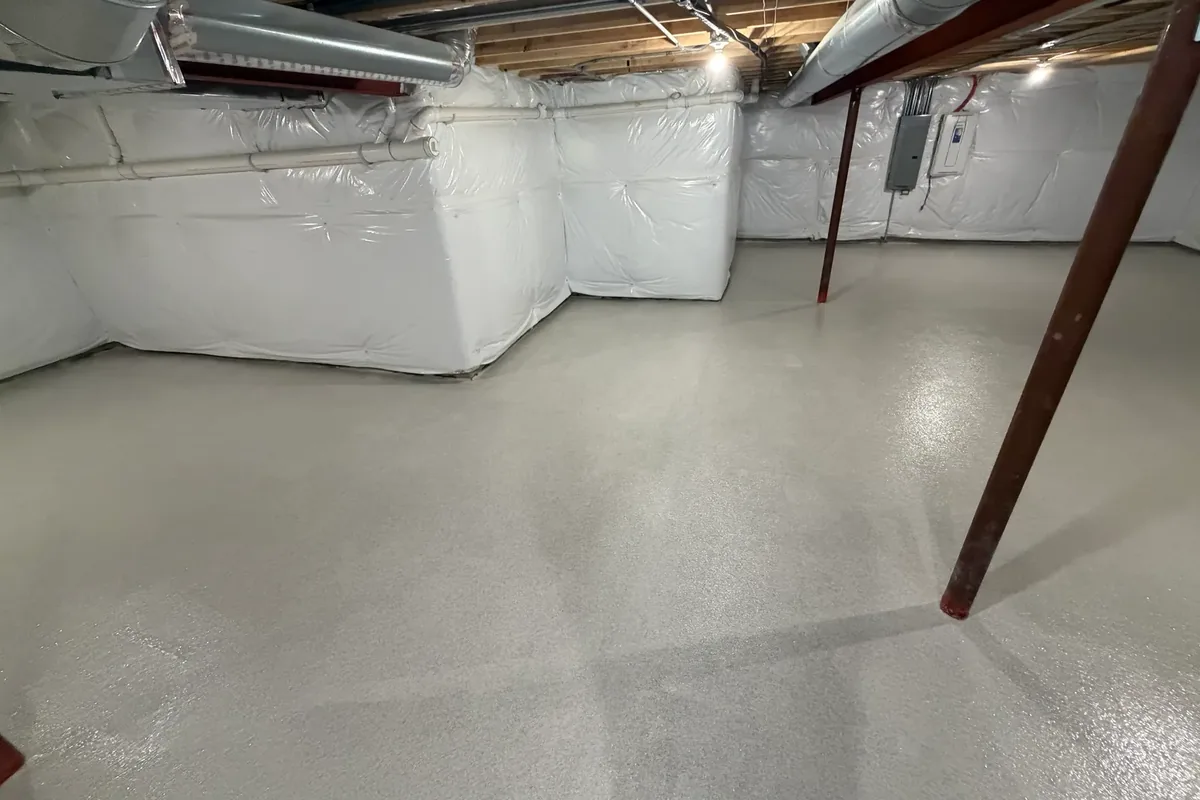
Same room, same columns. The floor now runs as one continuous surface around each column base.
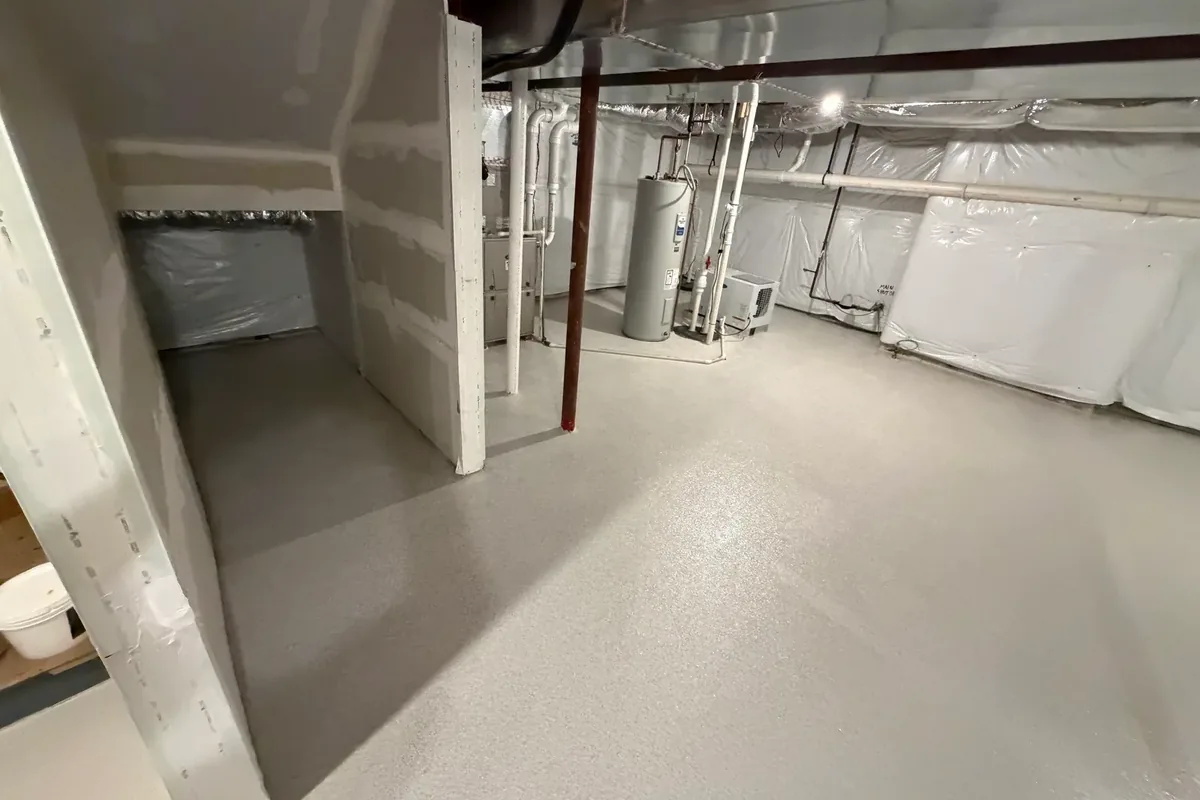
It also carries under the stairs and into the utility area around the water heater, so there's no bare concrete left in the corners of the room.
The homeowner, Marek W., left this review on Google:
“Flexible service arrangements, excellent communication throughout, a skilled team, and very reasonable pricing. I obtained three quotes, and while one matched Concrete Shield Coatings price, they started out considerably higher. I am pleased with the end product, and would not hesitate to use them again.”
Every photo, the before-and-after slider and the job specs are on the Woodridge basement floor project page.
Why Did This Basement Floor Cost $4.69 Per Square Foot?
At the bottom of our usual $5.50 to $7 range, 1,600 square feet would be $8,800. This job came in $1,300 under that. Three things explain most of it:
- Size. Setup, travel and equipment cost about the same whatever the size of the floor. Spread over 1,600 square feet, those fixed costs add less to each foot.
- Nothing to repair. No cracks to fill, no patching and no old coating to grind off.
- A short job list. The only extra listed on this job is the custom OPAL color. There's no wall-base coating and no slip-resistant grit on it, and both of those add cost on the garages we coat.
That doesn't make $4.69 a quote for your basement. It's what this floor cost, in this condition.
Woodridge vs. Lockport vs. Antioch
In the same month we coated a second basement in Lockport, also in Opal flake. We've also published the invoice for a two-car garage in Antioch. Side by side, they show what size and condition do to the price.
| Woodridge basement | Lockport basement | Antioch garage | |
|---|---|---|---|
| Floor size | 1,600 sq ft | 1,300 sq ft | 520 sq ft |
| Concrete going in | New, no cracks, no coating | Existing coating | Standard prep |
| Add-ons | Custom color | None listed | Stem wall, slip grit |
| Install time | 1 day | 2 days | 1 day |
| Total | $7,500 | $6,724.35 | $3,324 |
| All-in per sq ft | ~$4.69 | ~$5.17 | ~$6.39 |
Lockport is the useful comparison. It's 300 square feet smaller and cost only $775.65 less, and it took an extra day. The floor already had a coating on it, so it had to be ground to give the new system something to grip. When you compare basement quotes, ask what's being done about the concrete you have, not only what's going on top of it.
For a national reference, Bob Vila's cost guide puts polyaspartic floor coatings at $4 to $9 per square foot. Both of these basements fall inside that range.
The Basement Question: Is the Slab Dry Enough?
A basement slab sits against the ground, so moisture coming up from below is the first thing to check. New concrete also has water of its own left to lose.
We want at least 28 to 30 days of cure before anything goes on a fresh slab. That's a minimum, not proof the slab is dry. In a Q&A for the Journal of Light Construction, Concrete Construction's Bill Palmer estimates a 4-inch slab takes three to four months to reach 85% relative humidity under typical conditions. So it's worth measuring.
These are the three common tests, as coatings manufacturer Tnemec describes them:
| Test | How it works | What you learn | Primer limit |
|---|---|---|---|
| Plastic sheet (ASTM D4263) | Plastic taped down for 24+ hours | If moisture is near the surface | No number |
| Calcium chloride (ASTM F1869) | Sample weighed after collecting vapor | How much vapor leaves the slab | About 3 lb* |
| Humidity probe (ASTM F2170) | Probe in a hole at 40% of slab depth | Moisture inside the slab | 75 to 80% RH |
*Pounds of vapor per 1,000 sq ft over 24 hours.
Those limits are general guidance for conventional primers. Specialty primers are made for much higher readings, and the data sheet for the product going down has the final say. Any test is also a snapshot. Tnemec notes results may not hold year-round and recommends running the building's HVAC for at least 48 hours first.
Our basement floor pricing includes a moisture and relative humidity test. If a slab reads high, a moisture-mitigating primer or extra prep gets written into the quote before work starts. An active leak has to be fixed first. No coating is the fix for water coming through a slab.
From Our Side: What This Job Shows
An unfinished basement is the easy time to do it. There were no baseboards to work around and no carpet to pull up. If you're planning to finish a basement someday, or just want it clean and usable in the meantime, this is when the whole floor is open to the grinder.
Big doesn't have to mean slow. With no repairs on the list, the crew could go straight from grinding to coating, and 1,600 square feet went down in a single day. Don't expect that everywhere, though. Basements can take two to three days depending on size and condition, and Lockport's smaller floor took two.
Light flake suits a basement. A basement doesn't get much daylight, and a pale floor like this one makes the most of the light fixtures that are there. Compare the before and after photos of this room and you can see the difference.
Getting three quotes is smart, if they cover the same work. Marek W. got three, and one of them came down to match ours after starting considerably higher. Before you compare totals, ask each contractor how the slab gets prepped, whether moisture gets tested, what the base coat and topcoat are, and what isn't included.
Can You Coat a Basement Floor in Winter?
Yes, and November is a good time to plan it. A basement is indoors, so winter doesn't shut the work down the way it does an outdoor job. Interior basement work with polyurea runs all winter, and booking in the cold months can beat the spring rush. What should wait is concrete still curing, a slab with active moisture or a floor that needs structural repair first.
Frequently Asked Questions
How much does it cost to coat a 1,600 sq ft basement floor?
Our 1,600 sq ft polyurea flake basement floor in Woodridge, IL came to $7,500, about $4.69 per square foot. That was a new slab with no cracks and no old coating. Our polyurea flake floors typically run about $5.50 to $7 per square foot installed, and repairs, an old coating or a moisture problem can move the price. We give an exact price only after seeing the concrete.
Why would a large basement cost less per square foot than a garage?
Setup, travel and equipment cost about the same on a big floor as on a small one, so a larger floor spreads those costs over more square feet. On our Woodridge job the slab also needed no repairs, and the job list shows no wall-base coating or slip-resistant grit. Our 520 sq ft Antioch garage, which had both of those add-ons, came to about $6.39 per square foot.
How long after pouring a new basement slab can you coat it?
We want at least 28 to 30 days of cure before anything goes on a fresh slab. Cure time alone does not prove the slab is dry, though. Concrete Construction's Bill Palmer estimates a 4-inch slab takes three to four months to reach 85% relative humidity under typical conditions, so moisture should be measured rather than assumed.
Does a new concrete basement floor need to be ground before coating?
Yes. A new slab can have a smooth, slick surface that gives a coating little to grip. On the Woodridge job we removed the sheen and contaminants and diamond ground the whole floor before the polyurea base coat, even though there was nothing to repair.
How long does a basement floor coating take to install?
Our 1,600 sq ft Woodridge basement took one day. It was walkable after about 12 hours and ready for full use after about 48 hours. Our 1,300 sq ft Lockport basement took two days. Basements can take two to three days depending on size and concrete condition.
How do you test a basement floor for moisture before coating?
The three common tests are a taped plastic sheet (ASTM D4263), a calcium chloride test (ASTM F1869) and an in-slab relative humidity probe (ASTM F2170). The plastic sheet only shows whether moisture is present near the surface. The other two give numbers you can check against the coating's product data sheet.
Can you coat a basement floor in winter?
Yes. Interior basement work with polyurea runs all winter in the Chicago area, and winter scheduling can beat the spring rush. The exceptions are new concrete still curing, slabs with active moisture and floors that need structural repair.
Thinking About a Basement Floor in the Western Suburbs?
Our Lombard team handled this job and serves Woodridge along with nearby towns like Downers Grove and Naperville. At the estimate we'll look at your concrete, explain what it needs and write down exactly what's included.
Use the “Get Free Quote” button above, or call (847) 999-6330 to book an on-site estimate.
Concrete Shield Coatings has installed epoxy and polyurea floor systems across Chicagoland since 2010. Request a free on-site estimate from your local Concrete Shield Coatings branch.