Almost every garage we measure has at least one crack in it.
Most homeowners assume that means a coating is off the table, or that the slab has to come out first. It almost never does.
This is the full story of a garage we finished in Palatine, Illinois in September 2026. The concrete was old and had never been coated. It had a crack running across the slab and etching across the surface. Below is what we checked, what we fixed, what it cost, and the cracks we won't coat over.
Quick Verdict
Yes, you can coat a cracked garage floor, as long as the cracks have stopped moving. Shrinkage cracks, hairline cracks and old settled cracks get cleaned out, filled and ground flush, then sealed under the coating. Cracks that are still moving, slabs that have heaved, and surfaces that are crumbling need repair first, because a coating bonds to the concrete and moves with it. On our Palatine job, crack filling was part of normal prep. The whole 470 sq ft polyurea flake floor came to $3,286.50 and went in in one day.
Which Cracks Can You Coat Over?
The American Concrete Institute's crack guide makes the key point: a repair that doesn't deal with the cause of a crack is often only temporary (ACI 224.1R, Causes, Evaluation, and Repair of Cracks in Concrete Structures). So before we price a floor, every crack in it goes into one of four groups.
| Crack type | How to spot it | What we do | Coat over it? |
|---|---|---|---|
| Hairline / shrinkage | Thin, random, spider-web or straight lines | Ground open, cleaned and filled during prep | Yes |
| Old settled crack | Wider at the surface, but both sides sit level | Loose concrete cleaned out, filled to match the width, ground flush | Yes |
| Active / moving | Gets longer or wider season to season, one edge starting to lift | Find out why it's moving before anything goes on top | Not yet |
| Heaved, spalled or crumbling | Raised edges, loose chunks, surface flaking off | Quoted as garage floor repair or resurfacing first | No |
The first two rows cover most garages in the Chicago suburbs. A slab shrinks as it cures, cracks somewhere, and then stays put for decades. Those are the cracks we fill and coat over every week.
Not sure which kind you have? Draw a pencil line across each end of the crack and write the date next to it. If the crack has grown past your marks a few months later, it's still moving. Tell your contractor that at the estimate.
The Case File: Palatine, IL, September 2026
The floor
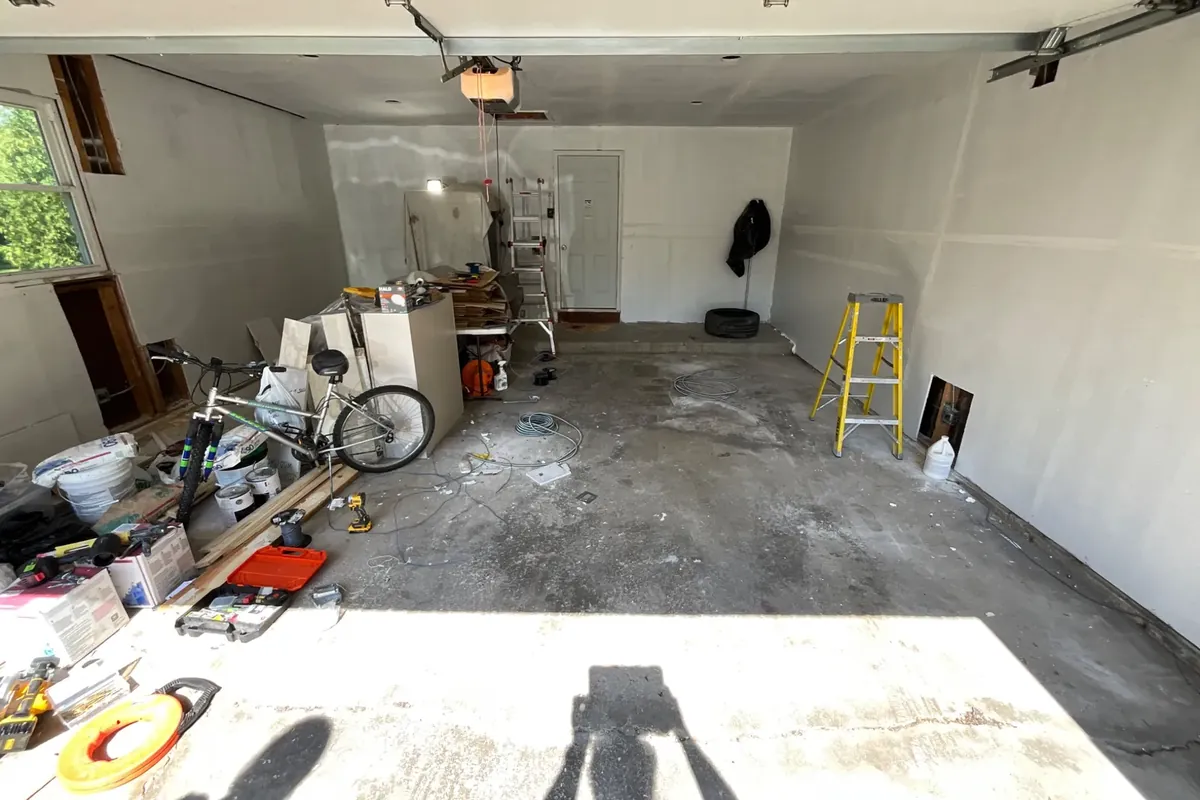
An attached two-car garage in Palatine. The concrete was older and had never been coated, so there was no peeling epoxy or paint to strip off. That's one less step.
The slab measured 470 square feet, and that included the outside edge at the garage door. The homeowner wanted the floor coated right up to the door line.
The problem
Two things. Cracks, including one that ran across the slab, and etching: the rough, worn look concrete gets when its top layer starts to break down. Neither one was serious. But both told us the surface needed real prep before anything would bond to it.
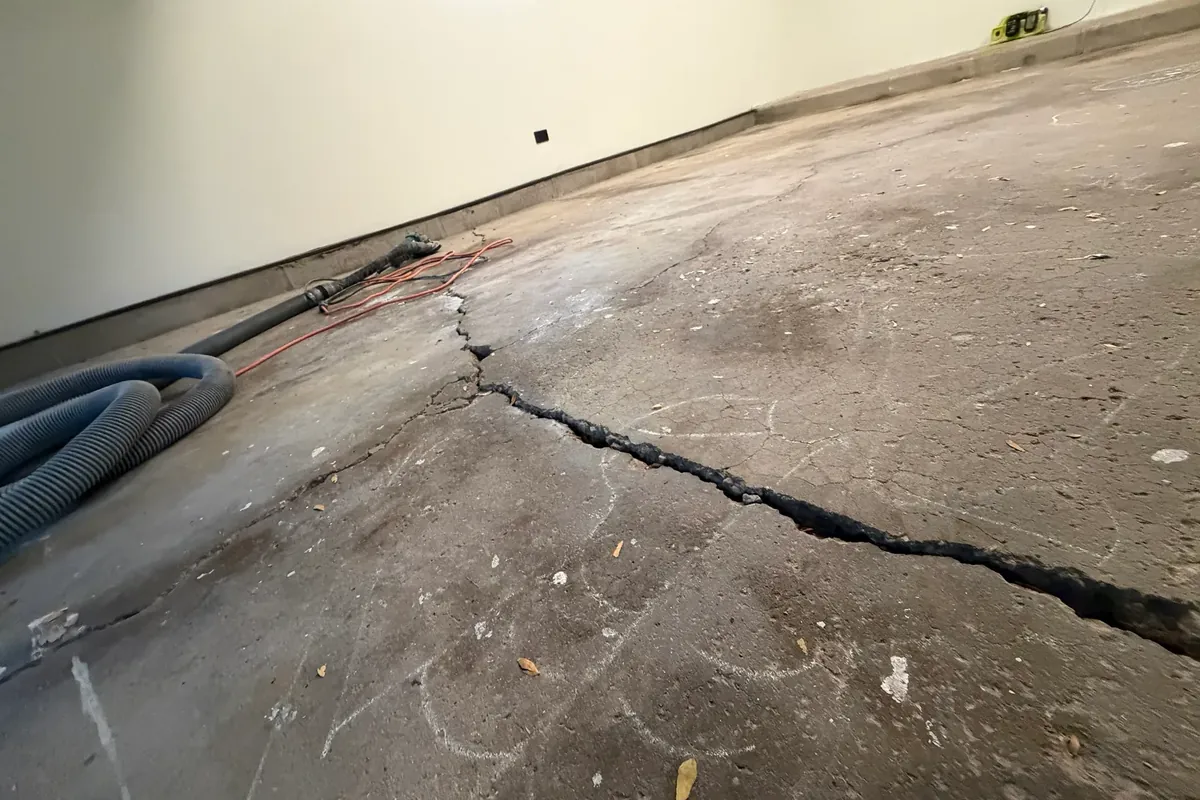
This is the main crack after grinding, and grinding makes every crack look worse. The surface is opened up, the edges are raw, and the chalk marks are the crew mapping what needs filling. What matters is that both sides sat level with each other. No lip, no heave. That's a crack that opened at some point and stopped, which means it can be coated over.
The fix: notes from install day
- Grind first. We diamond ground the whole slab to take off the sheen, the contaminants and the weak etched layer. Grinding leaves a consistent texture for the coating to grip, the kind of profile described in ICRI's concrete surface profile guideline. It also exposes hairline cracks you couldn't see on the dirty surface.
- Chase the cracks. Loose concrete was cleaned out of every crack, then each one was filled with a filler matched to its size. This happens before the base coat. Pour a coating over an open crack and it only hides it for a while. Sooner or later it shows back through.
- Base coat. A polyurea base coat went over the floor and up 40 linear feet of wall base, so the joint between slab and wall is one continuous seal.
- Flake. The owner's custom Schist flake blend was broadcast into the wet base until it wouldn't take any more, which is called broadcasting to rejection. A full broadcast covers the old surface completely, filled crack lines included.
- Topcoat. Scrape, vacuum, then a clear polyaspartic topcoat with aluminum-oxide grit mixed in for traction underfoot.
- Done. One day. Walkable after about 12 hours, ready for cars after about 48.
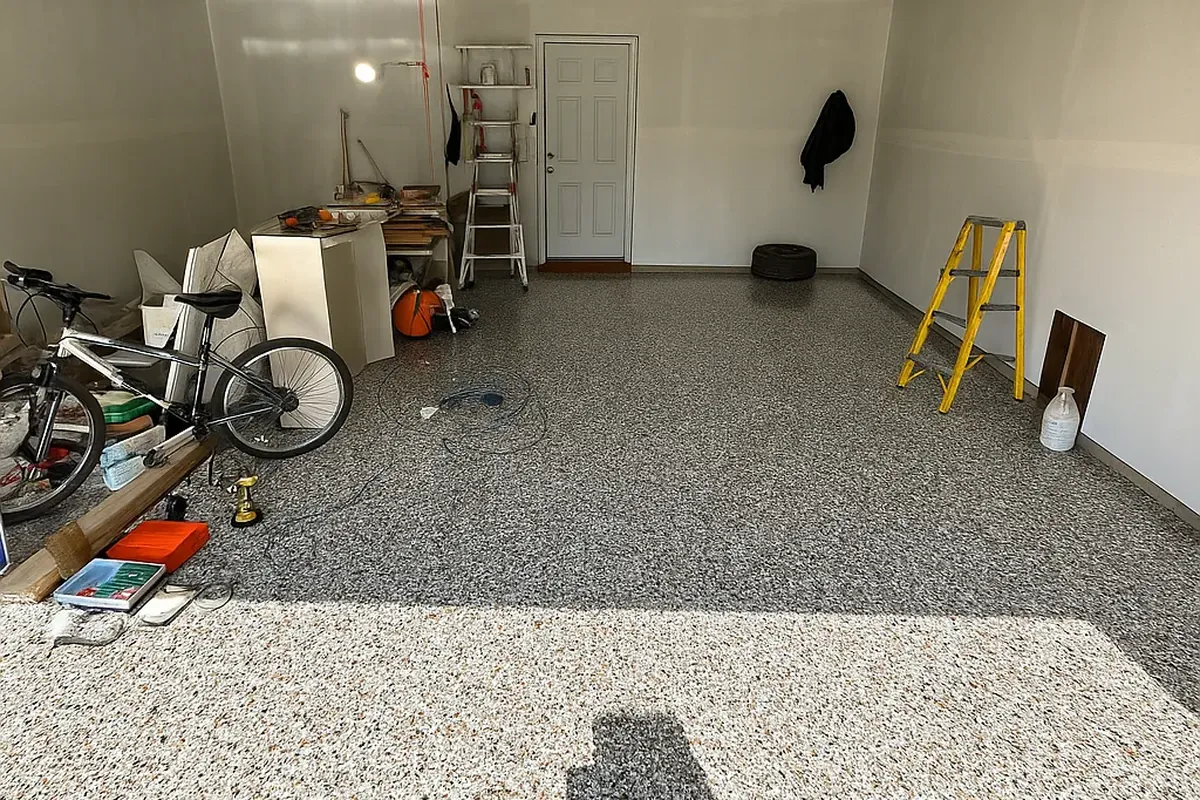
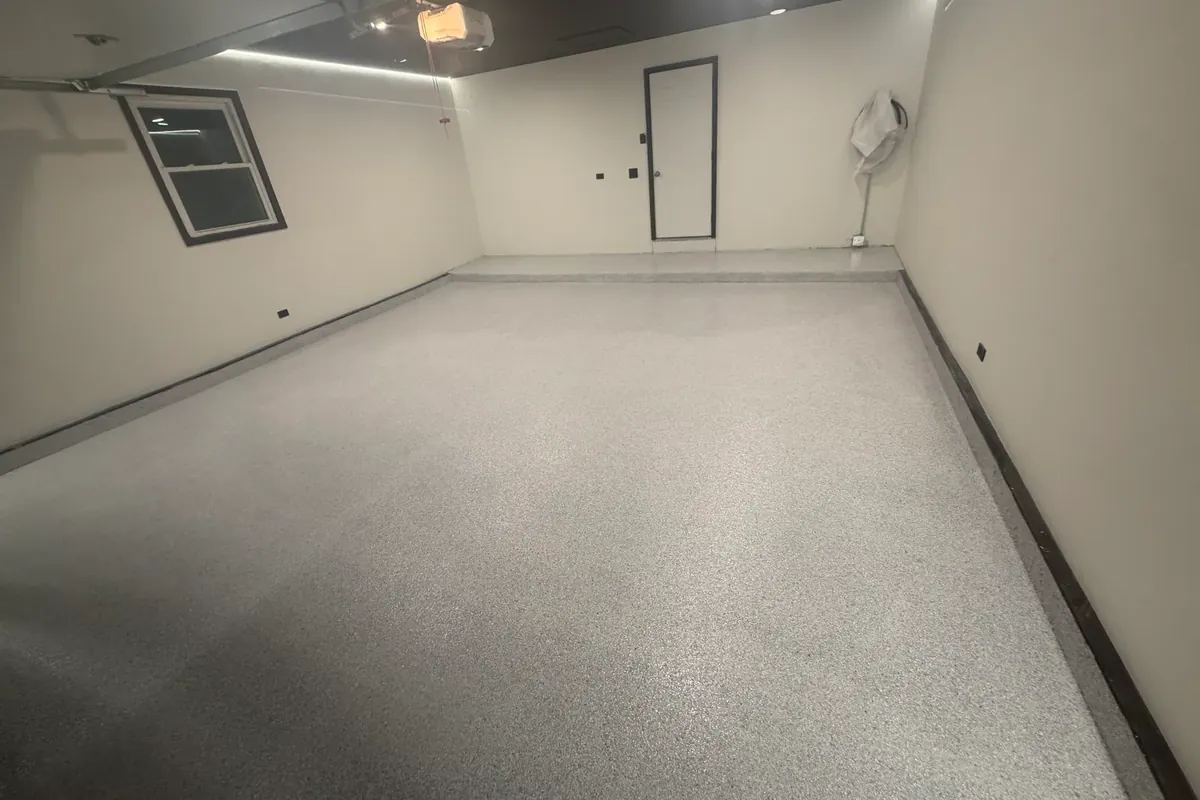
Before install day, the homeowner saw the Schist blend on a photo of their own garage, as in the preview above. A custom blend is a big decision to make from a 4-inch chip, so we show it on the actual floor first.
The result
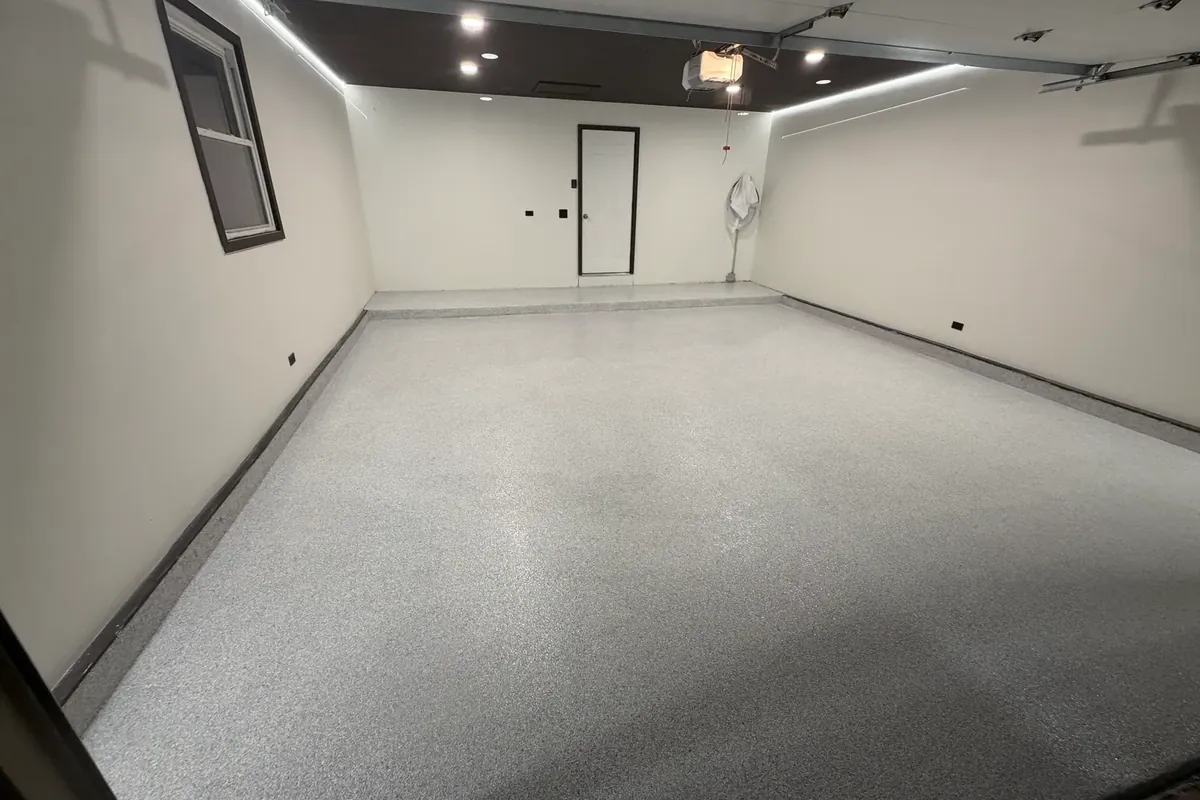
Under a full flake broadcast, the filled cracks don't show through the finish. Look along the base of the walls and you can see the 40 feet of coated wall base, which keeps snowmelt and salt brine from sitting where the slab meets the wall.
The homeowner, Marcin K., left this on Google afterward:
“Dmitry and his crew at Concrete Shield Coatings did a fantastic job on my garage floor. They beat the competition on price, maintained total professionalism, and got the entire job done in one day without cutting any corners.”
You can see every photo, the before-and-after slider and the job specs on the Palatine garage floor project page.
What Did It Cost to Coat This Cracked Garage Floor?
$3,286.50, all in. That price covered:
- 470 sq ft of polyurea / flake / polyaspartic floor, including the outside edge at the door
- Diamond grinding, plus crack cleaning and filling, as part of prep
- 40 linear feet of vertical wall-base coating
- Aluminum-oxide slip resistance across all 470 sq ft
- A custom Schist flake blend
That's about $6.99 per square foot all-in, at the top of our usual $5.50 to $7 range for a residential polyurea flake floor.
Antioch vs. Palatine: same size class, different jobs
The same month, we coated a two-car garage in Antioch and published that invoice line by line. Side by side, the two jobs show where the money in a garage floor actually goes.
| Antioch | Palatine | |
|---|---|---|
| Floor size | 520 sq ft | 470 sq ft |
| Concrete going in | Standard prep | Old, cracked, etched |
| Wall base coated | 60 ln ft | 40 ln ft |
| Outside edge at the door | Not included | Included |
| Flake | Stock gray, black and white blend | Custom Schist |
| Install time | 1 day | 1 day |
| Total | $3,324.00 | $3,286.50 |
| All-in per sq ft | ~$6.39 | ~$6.99 |
The Palatine floor is 50 square feet smaller and cost only $37.50 less. Three reasons:
- Fixed costs don't shrink. Setup, travel and grinder changeovers cost about the same on 470 sq ft as on 520, so a smaller floor carries a higher rate per foot.
- Custom flake. Stock blends are in the base price. Custom blends like Schist carry a charge, and it's priced before the job.
- The outside edge. Palatine's square footage ran out to the door line. Antioch's stopped at it.
Notice what isn't on that list: the cracks. On this job, cleaning and filling them was part of the floor price, not a separate line. A slab with a lot of cracks, wide joints or spalled edges is a different story. That work is priced on its own and written on the quote before anything starts.
For a national comparison, HomeGuide's garage floor coating cost guide puts polyurea at $5 to $10 per square foot, or $2,000 to $5,800 for an average two-car garage. It also lists concrete resurfacing for badly damaged floors at $3 to $7 per square foot, before any coating goes on. That's what a crack you can't coat over really costs.
From Our Side: When We Say No
We'd rather lose a job than coat over a crack that's going to come back through the floor. At the estimate, these are the things that make us stop and talk before we quote:
- One side of a crack sits higher than the other
- The homeowner tells us the crack has grown since last winter
- A section of slab rocks underfoot or sounds hollow when tapped
- The surface is flaking off in patches after years of road salt
In those cases the honest answer is to repair first and coat second. George D. from our team puts it this way:
“Most cracks we see in Chicagoland garages are old news. The slab shrank, it cracked, and it stopped. Those we fill and coat over every week. The ones we won't coat over are the cracks that are still moving. A coating is bonded to the concrete, so if the slab moves, the floor moves with it. We'll tell you that at the estimate, not after the install.”
Why Fix Garage Floor Cracks Before Winter?
An open crack in a Chicagoland garage takes on water all winter. Snowmelt runs off the car, settles into the crack, freezes and expands. Then the road-salt brine follows it in. The National Ready Mixed Concrete Association lists freeze-thaw damage among the common causes of cracking in its Concrete in Practice series, and every freeze-thaw cycle works the edges of an open crack a little more.
A crack that's filled and sealed under a coating doesn't take on water in the first place. That's the case for doing it in October and not in April.
The timing still works. Polyurea and polyaspartic coatings cure down to a slab temperature of about 35°F, so we keep installing them through October and into winter. Epoxy needs the slab above roughly 55°F, so in an unheated garage its season usually ends in October.
Frequently Asked Questions
Can you put a coating over a cracked garage floor?
Yes, if the cracks are stable. Hairline, shrinkage and old settled cracks are cleaned out, filled and ground flush during prep, then sealed under the coating. Cracks that are still moving, heaved slabs and crumbling surfaces need repair first, because a coating bonds to the concrete and moves with it.
Will cracks come back through a garage floor coating?
A stable crack that's been cleaned out and filled before the base coat generally stays hidden under a full flake broadcast. Problems come from cracks that were coated over without being filled, or cracks that are still moving. No coating can stop a slab from moving underneath it.
How much does it cost to coat a cracked garage floor?
On our Palatine job, an older 470 sq ft two-car garage with cracks and etching came to $3,286.50 all-in, about $6.99 per square foot. That included crack filling, 40 linear feet of wall base, slip resistance and a custom flake blend. Most two-car polyurea flake floors we install land between about $2,000 and $3,500.
Does crack repair cost extra?
Not for a few routine cracks. On the Palatine job, cleaning and filling them was part of the floor price. A slab with many cracks, or with spalls and pitting to patch, gets that work priced separately on the quote before anything starts. Heaved or crumbling concrete is a separate repair or resurfacing job.
How can I tell if a garage floor crack is still moving?
Mark both ends of the crack with a pencil and date the marks. If it grows past them over a few months, or one edge starts to sit higher than the other, it's still moving. Mention it at your estimate so it gets looked at before anything is coated.
Can you coat a cracked garage floor in October?
Yes. Polyurea and polyaspartic systems cure down to about a 35°F slab temperature, so we install them through October and into winter. Doing it before winter also means water and road salt can't keep working into the open cracks.
Got a Cracked Garage Floor in the Northwest Suburbs?
Our Northbrook team handles garage floor coating in Palatine and the surrounding towns. At the estimate we'll look at every crack, tell you honestly which group it's in, show you flake blends on a photo of your own floor, and write down exactly what's included.
Use the “Get Free Quote” button above, or call (847) 999-6330 to book an on-site estimate.
Concrete Shield Coatings has coated garage floors across Lake County, Cook County and the Chicago suburbs since 2010. Request a free on-site estimate from your local Concrete Shield Coatings branch.