
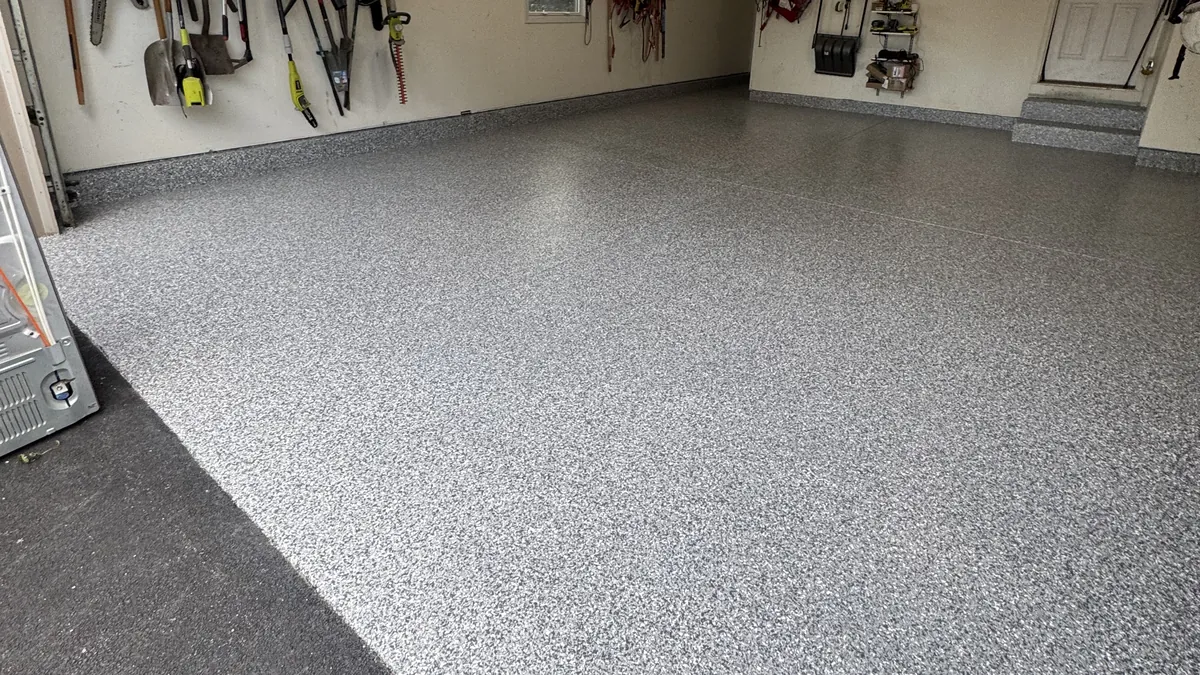
Search “garage floor coating cost” and you get a range so wide it's useless: $1,600 to $6,900 for a two-car garage. That's true nationally, and it tells you almost nothing about what your garage will cost.
So instead of another range, here's one real job. A two-car garage in Antioch, Illinois, coated on September 25, 2026. Every line of the quote, what each line paid for, what wasn't included, and how the day actually went. The homeowner stays anonymous; the numbers don't.
Key Takeaways
- Final invoice: $3,324 for a 520 sq ft two-car garage, no change orders.
- That's $6.39 per square foot all-in, or $5.50 per square foot for the floor itself.
- Three line items: floor coating ($2,860), coated stem walls ($360), slip-resistant additive ($104).
- System: polyurea base coat, decorative flake broadcast to full coverage, clear polyaspartic topcoat.
- Installed in one day, 8 AM to 5 PM. Walkable in about 12 hours, parked on in about 48.
- Not included: the outside edge of the slab past the garage door.
- The two add-ons were 14% of the price and are the easiest lines to adjust if budget is tight.
The Short Answer
A 520 sq ft two-car garage floor coating in Antioch, IL cost $3,324: $2,860 for the polyurea flake floor at $5.50 per square foot, $360 for 60 linear feet of vertical stem-wall coating at $6.00 per foot, and $104 for an aluminum-oxide slip additive at $0.20 per square foot. It was installed in a single day and ready to park on in about 48 hours.
For comparison, HomeGuide's national garage floor coating cost data puts polyurea at $5 to $10 per square foot, and a 576 sq ft two-car garage at $2,300 to $6,900. This job sat near the low end of that band while including two upgrades most national figures leave out.
The Job at a Glance
| Location | Antioch, IL 60002 (Lake County) |
|---|---|
| Space | Attached two-car garage, 520 sq ft |
| System | Polyurea base coat → decorative vinyl flake → clear polyaspartic topcoat |
| Flake coverage | Full broadcast (100% to rejection) |
| Vertical surfaces | 60 linear feet of stem walls and toe-kicks |
| Add-on | Aluminum-oxide slip-resistant aggregate in the topcoat |
| Install date | September 25, 2026, 8 AM – 5 PM (one day) |
| Final invoice | $3,324 ($6.39 / sq ft all-in) |
Before: The Garage at the Estimate Visit
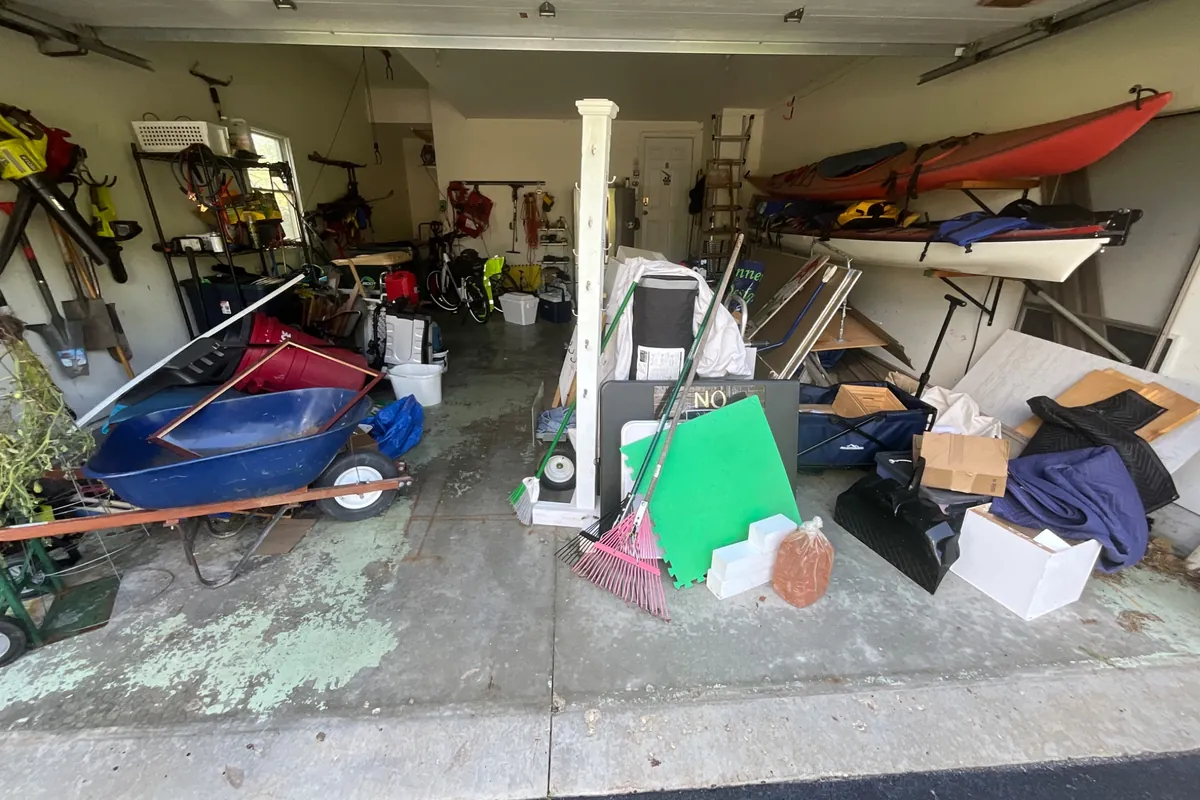
This is what we saw when we came out to measure: a working garage, full of tools, kayaks, a wheelbarrow and a season's worth of yard gear. That's normal. Almost nobody has an empty garage when they call us, and a crowded floor doesn't change the quote.
What the estimate visit actually settles is three numbers: the square footage of the slab, the linear footage of any vertical surfaces worth coating, and whether the concrete needs more than standard prep. Those three numbers became the three lines on the invoice below.
Picking the Look Before Install Day
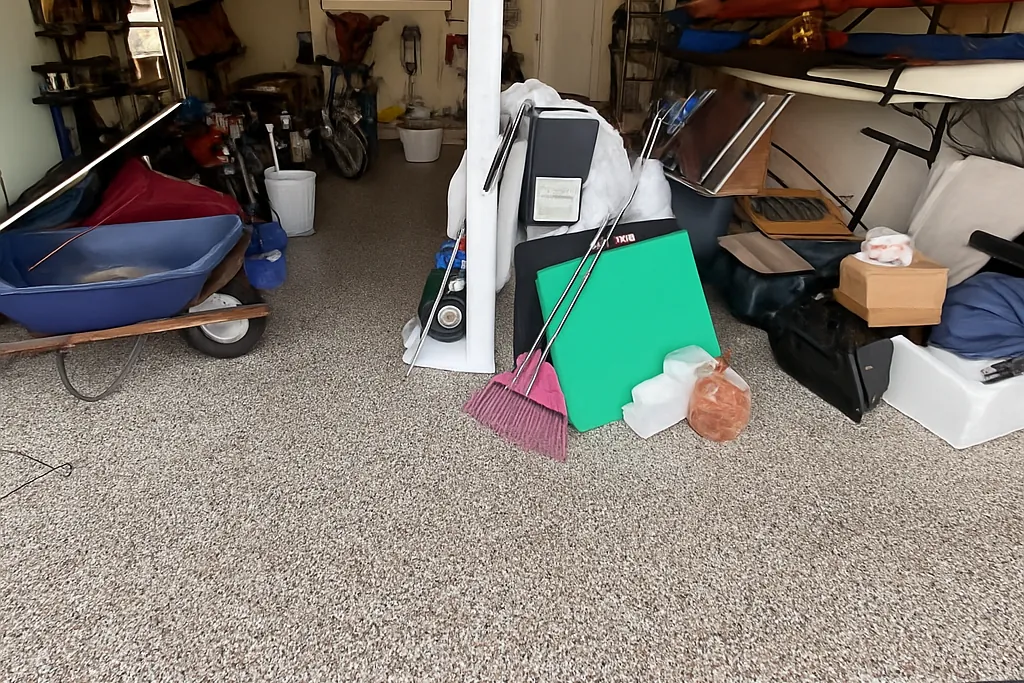
A 4-inch flake chip in your hand looks nothing like 520 square feet of the same blend under garage lighting. So we render blends onto a photo of the homeowner's own floor. It's the fastest way to rule a color in or out before anything is ordered.
The render above is one of those previews. The floor that went down ended up in a gray, black and white blend, which you can see in the finished photos. You can browse the full range of flake blends we stock; for anything beyond that, the flakes come from Torginol's flake flooring line, and custom blends are priced before the job, not after.
The Quote, Line by Line
| Line item | Quantity | Rate | Amount |
|---|---|---|---|
| Garage floor coating (polyurea / flake / polyaspartic) | 520 sq ft | $5.50 / sq ft | $2,860.00 |
| Vertical surface coating (stem walls, toe-kicks) | 60 ln ft | $6.00 / ln ft | $360.00 |
| Slip resistance (aluminum oxide) | 520 sq ft | $0.20 / sq ft | $104.00 |
| Total | $3,324.00 | ||
Line 1: The floor — $2,860
This is the whole coating system on the horizontal slab, and it's where most of the labor lives. The $5.50 per square foot covered surface prep, filling ordinary cracks and imperfections, a polyurea base coat, a full flake broadcast, scraping and vacuuming, the clear polyaspartic topcoat, and cleanup.
Crack filling being included matters. On our quotes it's part of prep, not a surprise line: cracks are cleaned of loose concrete and filled with a filler matched to the crack size. What isn't included in that rate is structural damage — spalled, heaved or badly scaled concrete is a separate garage floor repair job, and it's quoted as one.
Line 2: The stem walls — $360
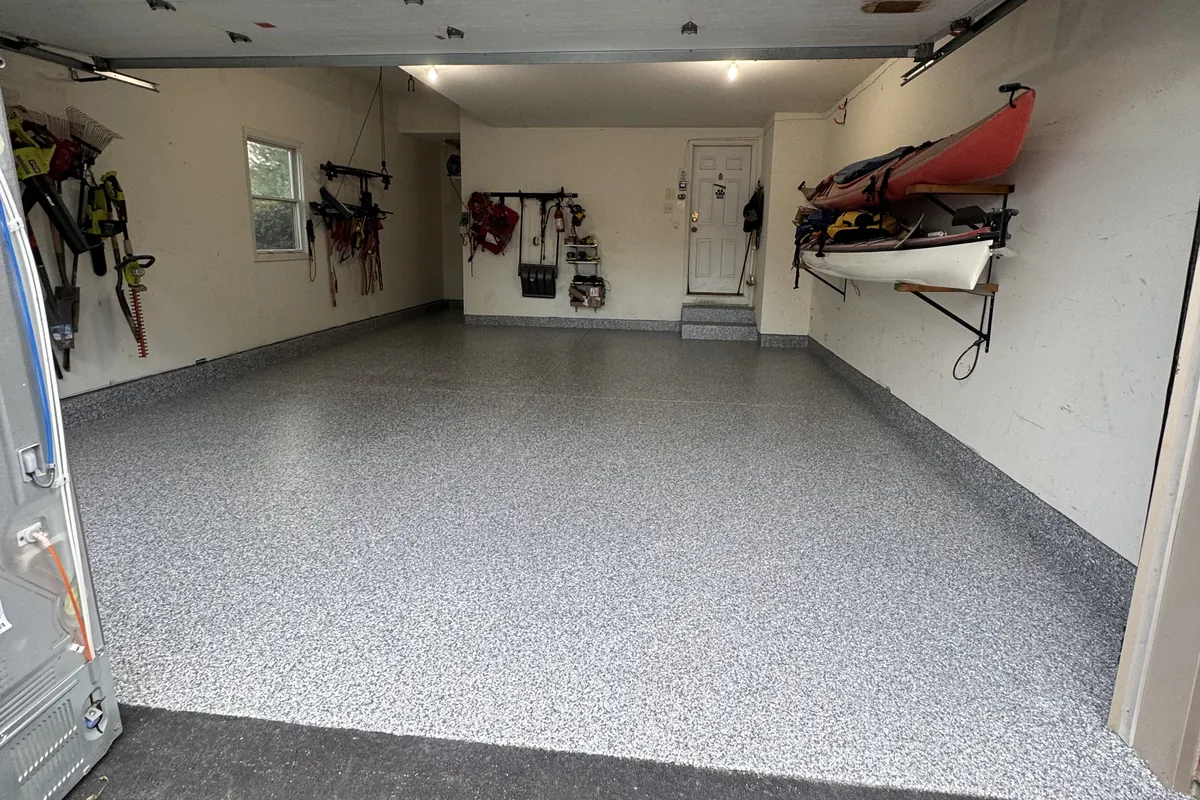
Stem walls are the short concrete faces where the slab meets the framed wall. Leave them bare and you get a hard line where the coating stops, which is exactly where water, salt brine and dirt collect. Coat them and the floor becomes one continuous, monolithic seal from the slab up the wall.
They're billed per linear foot, not per square foot, because the work scales with length: every foot gets profiled by hand, detailed at the corner, and coated on a vertical surface where material wants to sag. Sixty feet ran $360. Look along the base of the walls and the step up to the house door in the finished photos and you can see what that line bought.
Line 3: Slip resistance — $104
Aluminum-oxide aggregate is broadcast into the topcoat to add texture underfoot. A garage in Lake County spends a good part of the year with snowmelt dripping off cars, and a glossy topcoat can get slick when wet.
At twenty cents a foot it's the cheapest line on the invoice. It's also worth being honest about: slip resistance reduces the risk of slipping, it doesn't eliminate it. Standing water, oil, grease, snow, ice or loose debris can still make any floor slick. Keep it clean and dry and it does its job.
How the Install Day Went
The quote estimated one to two days, weather dependent. It took one: the crew started at 8 AM on September 25 and was done by 5 PM. Here's the order of work.
- Surface prep. Surface sheen and contaminants removed, then the slab diamond ground and the stem walls mechanically profiled to open the concrete up for adhesion. The industry reference for this is ICRI's surface-profile guideline, which grades prepared concrete on a scale of 10 texture levels — ICRI Technical Guideline 310.2R — and it's the reason grinding, not acid etching, is our default.
- Repairs. Any cracks cleaned out and filled, imperfections patched.
- Polyurea base coat. Applied over the floor and carried up the stem walls.
- Flake broadcast. Decorative flakes thrown into the wet base coat until it won't accept any more — “to rejection.” A full broadcast hides the concrete completely and gives the topcoat a uniform bed.
- Scrape and vacuum. Once cured, loose and standing flakes are scraped off and vacuumed so the surface is even.
- Polyaspartic topcoat. The clear, UV-stable wear layer, with the aluminum-oxide aggregate broadcast into it.
- Cleanup. Job site cleaned before the crew left.
Cure times we gave the homeowner: walkable in about 12 hours, ready for full use — cars included — in about 48 hours. Temperature and humidity move those numbers a little in either direction.
What Wasn't in the Price
- The outside edge of the slab. The concrete past the garage door wasn't part of the 520 sq ft. You can see where the coating ends at the door line in the photos.
- Custom flake blends. Standard blends are in the per-foot price. Custom colors can carry an extra charge, and we price them before the job.
- Structural concrete repair. Routine cracks are included; slab damage that needs resurfacing is a separate scope.
None of these are hidden — they're written on the quote. That's the point of a line-item estimate: you see exactly what's in and what's out before you sign.
How $6.39 per Square Foot Compares
Our usual range for a residential polyurea flake floor is $5.50 to $7 per square foot installed, which for most two-car garages means roughly $2,000 to $3,500. This job came in at $5.50 for the floor and $6.39 with both add-ons.
What pushes a garage toward the top of that range, or past it:
- Size. Smaller floors carry a higher rate per foot because setup, travel and grinding changeovers don't shrink with the slab.
- Slab condition. Old coatings to remove, oil-soaked concrete, or real damage all add prep time.
- Vertical work. More stem walls, steps and curbs mean more linear footage.
- Flake density and custom blends. A full broadcast uses more flake than a partial one; custom blends cost more than stock.
- System choice. Epoxy-based systems price differently from polyurea. Our epoxy flooring cost guide breaks that comparison down across garages and basements.
From Our Side: Why We Quote It This Way
We could have written this job up as one number. Plenty of quotes do. We split it into three lines because it's the most useful way for a homeowner to make decisions.
Look at what the split tells you. The floor is 86% of the price and non-negotiable if you want a coated floor. The other 14% is two choices you can actually weigh: $360 to seal the wall line and $104 for traction. If budget is tight, those are the lines to talk about. If you're comparing us against another quote, those are also the lines to check — a lower number that simply leaves out stem walls isn't the same floor.
The other thing the invoice shows is what didn't change. The estimate said $3,324 and the final invoice said $3,324. That only works when the estimate visit is done properly: measure the slab, measure the vertical faces, look at the concrete, and write down what's excluded.
Thinking About Your Own Garage This Fall?
This floor went down in late September, and that timing isn't a problem for this kind of system. Polyurea and polyaspartic coatings cure down to a slab temperature of about 35°F, so we keep installing them through October and into winter, while epoxy season ends much earlier. Our fall coating cutoff post lays out exactly what we still install as it gets cold and what waits for spring.
The practical upside of coating before winter: the first car that drips road salt onto the floor this year drips it onto a sealed surface instead of bare concrete.
Frequently Asked Questions
How much does it cost to coat a 2-car garage floor?
Most two-car garages we coat land between about $2,000 and $3,500 for a polyurea flake system. This 520 sq ft Antioch garage came to $3,324: $2,860 for the floor at $5.50 per square foot, $360 for 60 linear feet of stem walls, and $104 for a slip additive — $6.39 per square foot all-in. National data puts a two-car garage anywhere from $1,600 to $6,900.
Why are garage stem walls priced per linear foot instead of per square foot?
Because the labor follows length, not area. Every foot of stem wall is ground by hand, detailed where it meets the slab, and coated on a vertical surface. Pricing by the linear foot keeps the charge proportional to that work. Here, 60 feet at $6.00 added $360 and sealed the floor-to-wall joint.
Is slip resistance worth adding to a garage floor coating?
For most garages, yes — especially in a snow climate. Aluminum-oxide aggregate in the topcoat improves traction when the floor is wet, and on this garage it cost $104. It reduces the risk of slipping but doesn't eliminate it; water, oil, snow, ice or debris can still make any floor slick.
How long does it take to install a polyurea flake garage floor?
One to two days for a typical two-car garage. This one was finished in a single day, 8 AM to 5 PM. The floor was walkable in about 12 hours and ready to park on in about 48.
What is not included in a garage floor coating quote?
It depends on the contractor, which is why a line-item quote matters. On this job the outside slab edge past the door was excluded, and vertical surfaces and slip resistance were separate lines. Grinding, routine crack filling, flakes, topcoat and cleanup were all included in the floor price.
Can you still coat a garage floor in the fall in northern Illinois?
Yes, with polyurea and polyaspartic systems, which cure down to about a 35°F slab temperature. We install them through October and into winter. Epoxy needs the slab above roughly 55°F, so in an unheated garage its season usually ends in October.
Want a Line-Item Quote for Your Garage?
We'll measure the slab and the vertical faces, look at the concrete, show you flake options on a photo of your own floor, and write down exactly what's included and what isn't — the same way we did in Antioch.
Use the “Get Free Quote” button above, or call (847) 999-6330 to book an on-site estimate.
Concrete Shield Coatings has coated garage floors across Lake County and the Chicago suburbs since 2010 — request a free on-site estimate from your local Concrete Shield Coatings branch.