
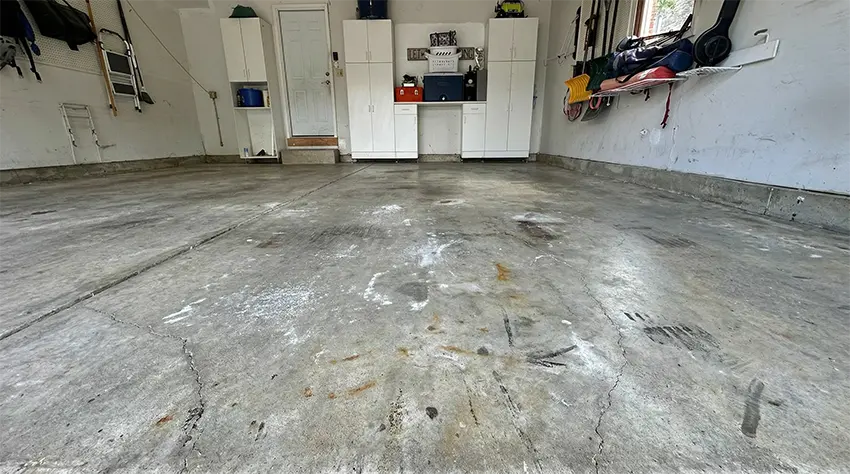
Every winter your car spends eight hours a night dripping brine onto the same four square feet of garage floor. Whatever is under those wheel wells is the most concentrated chemical exposure the concrete will ever see — worse than the driveway, because in the garage it never gets rained off.
So the question people ask us in October is fair: if I spend three thousand dollars on an epoxy garage floor, does the salt just eat that too?
Short version: no, and that's the whole point of a coating. But there's a real caveat, it's not the one most people expect, and it has nothing to do with the resin.
Key Takeaways
- Salt does not attack a cured coating. Epoxy and polyurea-polyaspartic are chemically resistant to chlorides. Brine sits on the film and does nothing.
- Salt attacks the gaps in a coating. Joints, apron edges, pinholes and bridged cracks are where brine gets underneath and lifts it.
- A coating with gaps is worse than no coating — it traps brine against concrete instead of letting it dry out.
- On bare concrete, salt works two ways: physical scaling from freeze-thaw, and chemical attack from calcium and magnesium chloride forming calcium oxychloride.
- Skip magnesium chloride. NRMCA guidance names magnesium-based salts as chemically aggressive and says they destroy concrete surfaces.
- The temperature on the bag is a lab number, not a working temperature. Rock salt advertises -6°F and stops melting usefully around 15°F.
- White blooms in the parking footprint are not stains. They map where chloride has been cycling through the slab.
The Short Answer
A properly installed, fully cured epoxy or polyurea-polyaspartic floor is chemically resistant to de-icing salts. You can park a salt-caked car on it all winter, rinse it in spring, and it looks the way it did in October.
What fails is never the middle of the floor. It's the edges. Every coating failure we've torn out that could be blamed on salt started at a joint, an apron edge, a pinhole or a crack — a place where the film stopped and the concrete started.
That makes this a question about installation quality, not about product chemistry. Which is worth understanding before you buy either a coating or a bag of ice melt.
What Road Salt Actually Does to Bare Concrete
“Salt eats concrete” is one of those things everyone repeats and almost nobody can explain. There are two distinct mechanisms, they behave differently, and telling them apart is what lets you buy intelligently.
1. Physical damage: scaling
This affects every chloride, including plain rock salt, and it isn't really chemistry at all.
Salt does two things to a slab: it keeps the surface wetter for longer, and it lowers the freezing point so the surface crosses back and forth over freezing far more often. NRMCA's technical bulletin on scaling concrete surfaces puts it plainly: de-icing chemicals make things worse by increasing saturation at the surface and increasing the number of freeze-thaw cycles.
Water expands roughly nine percent as it becomes ice. A saturated surface layer going through that dozens of times a season pops off in thin flakes — that's scaling. Properly air-entrained concrete resists it, because millions of microscopic air bubbles give the ice somewhere to expand into. NRMCA recommends about 6 percent total air content and 4,000 psi for exterior slabs facing freeze-thaw and de-icers. Plenty of residential garage slabs were poured without adequate entrained air, and salt is what finds that out.
2. Chemical damage: calcium oxychloride
This one is specific to calcium chloride and magnesium chloride, and it's genuinely destructive.
These salts don't just sit on the surface. They react with calcium hydroxide in the hardened cement paste to form calcium oxychloride — an expansive compound that grows inside the concrete and cracks it from within. It doesn't need a freeze-thaw cycle. It happens well above freezing, and it concentrates at joints and cracks where brine pools.
The research is extensive. A critical review of calcium oxychloride literature in Cement and Concrete Composites ties the phenomenon directly to calcium and magnesium chloride de-icers, with damage showing up as spalling and scaling around joints. Related durability work on concrete exposed to high CaCl2 and MgCl2 concentrations adds expansive cracking, increased permeability and significant compressive strength loss — and magnesium chloride carries an extra insult, converting the calcium silicate hydrate that gives cement its strength into a much weaker magnesium silicate hydrate.
Put simply: rock salt mostly does mechanism one. Calcium and magnesium chloride do both.
Now — notice that both mechanisms require the brine to reach the concrete. That's the entire argument for a coating, and also the entire reason a bad one fails.
So What Actually Fails on an Epoxy or Polyurea Floor?
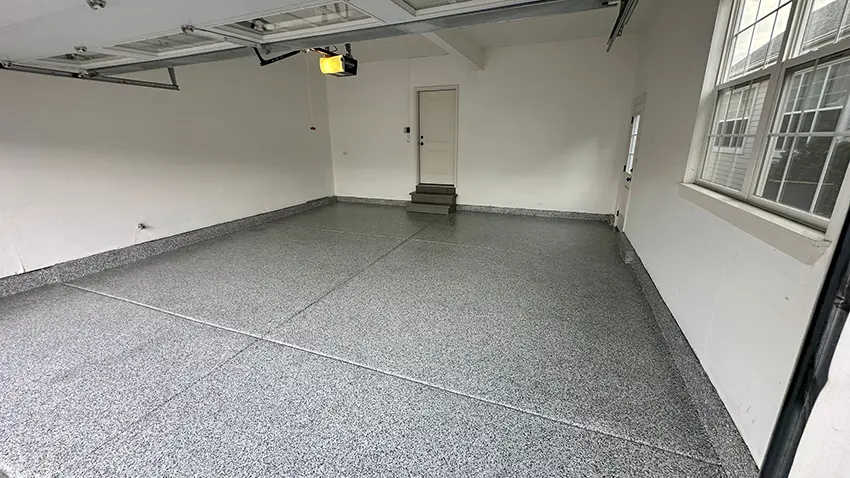
The resin film is not the weak point. Salt brine is simply relentless about finding the one place the film doesn't cover, and on a garage floor there are exactly four such places.
- Un-coated expansion and control joints. The most common failure by a wide margin. If joints weren't cut in, filled and coated through properly, brine runs straight into them and goes to work on the concrete from inside — which, as the research above shows, is precisely where calcium oxychloride damage concentrates anyway. The coating can be flawless everywhere else and the slab still degrades along every joint line.
- The apron edge at the garage door. This is the highest-exposure inch of the entire floor: it gets the meltwater, the wheel contact, the temperature swing and the direct weather. It needs a properly terminated edge — ideally a saw-cut anchor groove the coating locks into — not a film feathered out to nothing where a snow shovel will catch it.
- Pinholes from inadequate prep. Outgassing pinholes are microscopic funnels pointed straight at your slab. They come from coating concrete that wasn't mechanically profiled, or from applying while the slab is rising in temperature and pushing air up through the film. It's one of several reasons we diamond-grind every floor rather than acid-etch.
- Cracks that were coated over instead of repaired. A crack bridged with resin and no structural repair underneath will reopen with the next thermal cycle. Now it's a funnel with a lid — brine gets in, and the coating stops it evaporating back out.
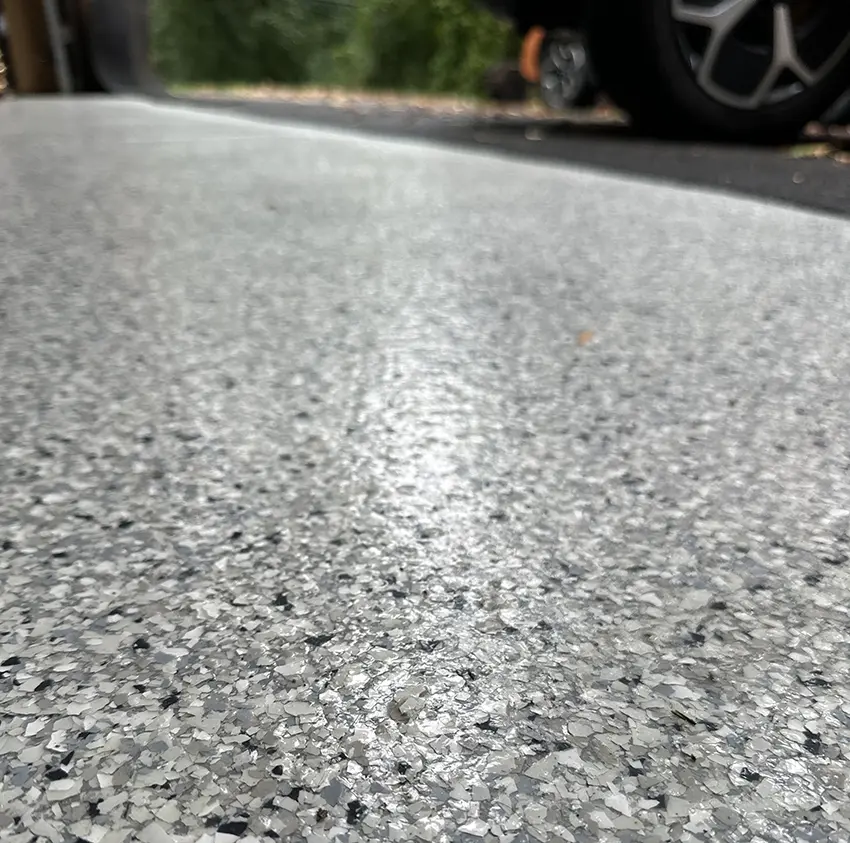
That last point generalizes, and it's the one worth taking away: a coating with gaps is worse than no coating at all. Bare concrete at least dries between storms. Concrete under a compromised film holds brine against itself indefinitely, which is why a cheap installation can leave a slab in worse shape than if nobody had touched it.
A continuous, edge-to-edge epoxy or polyurea system with correctly detailed joints and a terminated apron edge is genuinely salt-proof, and stays that way for decades. The difference is entirely in the installation, not the bucket.
What We Actually See Under the Grinder
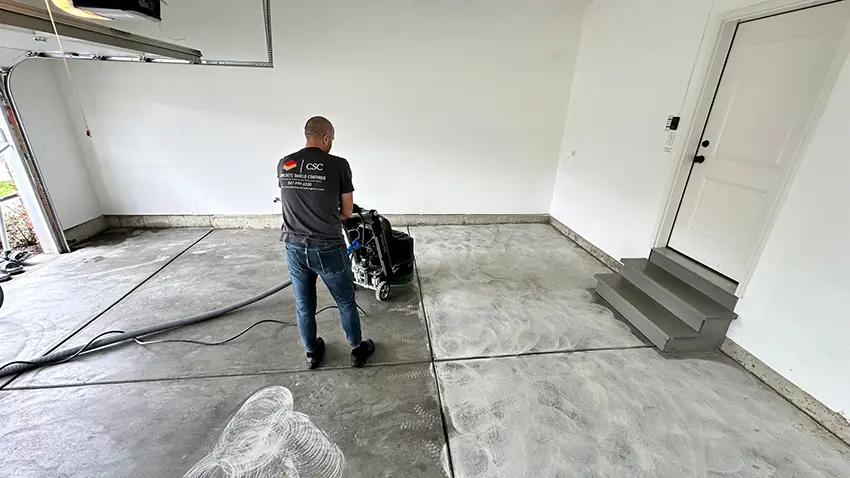
We've been coating concrete since 2010, and grinding is where a floor's winter history becomes visible. Prep isn't only about creating a bond profile — it's the first honest look at what fifteen winters did. Three patterns come up constantly.
The white bloom in the parking footprint
Look at the photo at the top of this article and notice where the chalky white patches are. They aren't random. They map the outline of where a car sat. That's salt and mineral residue carried in on tires and wheel wells, deposited in the same place every night, drawn into the pores of the slab and pushed back out as it dried.
Homeowners almost always call this “staining” and assume it's cosmetic. It isn't. It's a map of where chloride has been cycling in and out of the concrete, and the slab under those blooms is consistently more porous and weaker than the slab three feet away. It's also why we test rather than assume — slab moisture behavior matters enough that the industry has a standard method for it, ASTM F2170.
The soft first eighth-inch
On a salt-exposed slab the grinder tells you something no visual inspection can. The top layer comes off too easily — it powders instead of cutting. That's cement paste that's been chemically compromised and freeze-thaw cycled until it lost integrity.
This is where a job stops being a coating job. If the compromised layer runs deep enough, no coating bonds to it reliably, because you'd be gluing a durable film to a surface already letting go of itself. Those floors need repair and resurfacing first, and telling someone that is a worse conversation than quoting a coating.
The joint that failed first
When damage clusters at control joints and the apron edge rather than spreading evenly, the cause is usually drainage plus a stronger chloride. Brine pools in the low spot, sits there, and works. That's the calcium oxychloride pattern the literature describes — damage concentrated at joints — and once you've seen it a few times it's recognizable on sight.
The frustrating part is how avoidable it usually was. Not by buying a better bag of salt, but by fixing where the water goes.
Which Ice Melt Should You Use?
If your epoxy or polyurea floor is sound, this matters less than the internet suggests — the film is doing the work. If your floor is bare, or coated with gaps, it matters a great deal.
| De-icer | Eutectic (bag claim) | Realistic working temp | Risk to concrete | Cost |
|---|---|---|---|---|
| Calcium magnesium acetate (CMA) | ~ -18°F | ~ 20°F | Lowest. Chloride-free; no oxychloride reaction | Highest |
| Sodium chloride (rock salt) | ~ -6°F | ~ 15°F | Low–moderate. Physical scaling, not chemical attack | Lowest |
| Potassium chloride | ~ 12°F | ~ 20°F | Moderate. Weak melter, so people over-apply | Moderate |
| Urea | ~ 11°F | ~ 15–20°F | Low to concrete, but it's fertilizer — runoff issue | Moderate |
| Calcium chloride | ~ -60°F | ~ -20°F | Contested. Best melter; forms calcium oxychloride | Higher |
| Magnesium chloride | ~ -28°F | ~ 5°F | Highest. Named as destructive in NRMCA guidance | Higher |
| Ammonium sulfate / nitrate | — | — | Never use. Chemically destroys concrete surfaces | — |
Most retail bags are blends — usually rock salt with a small percentage of something stronger sprayed on. Which is why the ingredient panel on the back matters more than the headline on the front.
The Number on the Bag Is Not a Working Temperature
This is the most useful thing to understand about de-icers, and nobody selling them explains it.
The dramatic negative number on the front is the eutectic temperature — the coldest point at which a brine at exactly the ideal concentration, mixed perfectly, in a laboratory, stays liquid. Your driveway is not a laboratory. The brine on it is diluted by meltwater, spread unevenly, and sitting on cold concrete.
What matters is the lowest practical melting temperature, and the gap is enormous. Rock salt's eutectic point is about -6°F. Its practical floor is roughly 15°F. That's a twenty-degree lie of omission, and it's why people stand in a driveway at 10°F wondering why half a bag has done nothing.
The Minnesota Stormwater Manual's overview of de-icing chemicals is blunt about it: choose material by the lowest practical melting temperature, not the eutectic number printed on the bag.
The consequence is worse than wasted money. When a de-icer doesn't work, people apply more of it — and over-application is what drives the damage.
“Safe for Concrete” on the Label Means Nothing
There's no standard behind the phrase. No certifying body, no test method, no threshold a product has to clear. Same with “pet safe.” A manufacturer prints it because it sells bags.
We've seen magnesium chloride blends marketed under a concrete-safe banner while published industry guidance recommends against magnesium-based salts specifically. Not necessarily illegal. Just meaningless.
The only useful information is the ingredient panel on the back. Read it in this order:
- Calcium magnesium acetate or sodium acetate listed first? That's the gentle stuff. Buy it if the price doesn't bother you.
- Sodium chloride first, no magnesium? Fine. The sensible default.
- Magnesium chloride near the top? Put it back.
- Ammonium anything? Put it back immediately — that's fertilizer sold as ice melt, and it dissolves concrete surfaces.
- No ingredient panel at all? That tells you what you need to know.
Why the Advice Online Contradicts Itself
Search this for ten minutes and you'll find confident sources saying magnesium chloride is the concrete-safe choice, and equally confident sources saying it's the one that destroys slabs. Worth knowing which is which.
Traditional field guidance — including NRMCA's own bulletin — treats calcium chloride and sodium chloride as acceptable on concrete in moderation, and singles out ammonium sulfate, ammonium nitrate and magnesium-based salts as the ones that destroy concrete surfaces. A great deal of consumer content asserts the opposite without citing anything.
The laboratory research on calcium oxychloride is harder on calcium chloride than that field guidance is, because it uses high concentrations and long exposures that reveal chemistry a homeowner might never reach with light occasional use.
Our read, from floors rather than journals: concentration and drainage decide it. Calcium chloride applied lightly to a well-drained, air-entrained, mature driveway is a manageable risk. The same product piled at a garage apron where meltwater sits, or dripped off a car onto the same square foot every night all winter, is a completely different exposure. That second case is a garage floor — which is exactly why garage slabs fail in ways driveways don't, and why the coating conversation starts there.
How to Protect a Garage Floor Through Winter
None of this requires hiring anyone, and it does more than switching de-icer brands.
- Put a containment mat under each vehicle. Twenty to sixty dollars, catches the brine before it reaches concrete. For an uncoated garage floor this is the highest-return thing you can do, full stop.
- Use less de-icer than you think. It isn't meant to melt snow — it's meant to break the bond so you can shovel. Shovel first, then apply lightly to what's left.
- Use sand below about 15°F. Most consumer de-icers aren't working down there anyway. Sand gives traction and does nothing to concrete.
- Rinse the floor on thaw days. NRMCA says this explicitly — when conditions permit, wash off the salt cars deposit on driveways and garage slabs. On a coated floor this is also what protects the finish, since abrasion from ground-in grit dulls a coating faster than any chemical will.
- Fix the drainage. A downspout dumping beside the garage apron does more damage in one winter than a season of careful salting prevents.
- Never de-ice first-winter concrete. NRMCA is unambiguous: avoid de-icing chemicals in the first winter, moderate use after. Sand only.
- Seal bare exterior concrete. A breathable silane or siloxane concrete sealer reduces how much brine the slab absorbs. It needs dry concrete and warm weather — late summer or early fall, not the week before the first freeze.
The Honest Cost Comparison
- A season of de-icer: $30–$100 depending on product and winter.
- A containment mat: $20–$60, lasts years.
- Concrete sealing: roughly $1.25–$1.75 per square foot, reapplied every few years.
- A garage floor coating: $5–$7 per square foot installed — typically $2,000–$3,500 for a two-car garage, about $1,250–$2,100 for a one-car.
- Repairing a salt-scaled slab before it can be coated: generally $2,000–$4,500 on top of the coating.
- Replacing a slab that went too far: considerably more than all of the above combined.
That fifth line is the one that matters. The gap between coating a sound slab and repairing a damaged one is roughly the price of the coating itself — so salt damage doesn't just cost you a floor, it costs you the option of the cheap fix. Every residential system we install carries a lifetime warranty, and we're strict about slab condition precisely because we're the ones who come back if it fails.
Your Winter Floor Checklist
- Drip containment mat under each parked vehicle before the first snow.
- Read the ingredient panel on your ice melt — check for magnesium chloride and ammonium compounds.
- CMA if budget allows, plain rock salt if not, and keep sand for cold snaps.
- Shovel first, de-ice sparingly second.
- Confirm downspouts near the garage drain away from concrete.
- Rinse the floor on the first thaw day of each month.
- Epoxy or polyurea floor: inspect joints, the apron edge, and any crack repairs — that's where failure starts.
- Bare floor: look for white blooms in the parking footprint, flaking at joints, cracks wider than a credit card.
- If the surface powders when scraped with a screwdriver, get it looked at before adding another winter.
- Seal or coat before the season, not during it — both need warm, dry concrete.
Frequently Asked Questions
Does road salt damage an epoxy garage floor?
Not the coating itself. A properly installed, fully cured epoxy or polyurea-polyaspartic system is chemically resistant to de-icing salts, so brine dripping off a car doesn't attack the resin film. What fails is any gap in the coating: an un-coated expansion joint, a chipped or feathered apron edge, pinholes from inadequate prep, or a crack coated over instead of routed and repaired. Brine finds those gaps, wicks underneath, and lifts the coating from below. On a continuous, edge-to-edge installation with properly detailed joints, road salt is a non-issue.
Is ice melt safe to use on a coated garage floor?
Yes, on a sound coating. You can drive a salt-caked car onto a coated floor all winter, rinse it in spring, and it looks the same as it did in October — that's the entire reason coatings exist in salt-belt climates. The practical caution is physical rather than chemical: rinse periodically so grit and salt crystals aren't ground into the surface by tires and boots, since abrasion, not corrosion, is what dulls a coating over time.
My garage floor has white salt stains. Is it too late to coat it?
Usually not. White blooms in the parking footprint mean chloride has been cycling through the surface, but on most floors the compromised layer is shallow enough that diamond grinding removes it and exposes sound concrete underneath. The floors that can't be saved by grinding alone are the ones where the top layer powders instead of cutting — those need repair and resurfacing before any coating goes down. It's a fifteen-minute answer in person and a guess from a photo.
Which ice melt is safest for concrete?
Calcium magnesium acetate (CMA) is the safest widely available de-icer because it contains no chloride and doesn't drive the reactions that break down cement paste. It's also the weakest and most expensive, working only to roughly 20°F. For most homeowners the practical answer is plain rock salt used sparingly, being the least chemically aggressive of the cheap chlorides. Avoid magnesium chloride and blends built around it — NRMCA's scaling guidance states that magnesium-based salts are chemically aggressive and destroy concrete surfaces.
How does road salt actually damage bare concrete?
Two separate mechanisms. The first is physical: salt keeps the slab wetter longer and increases the number of freeze-thaw cycles the surface goes through, popping off flakes of surface mortar in a pattern called scaling. The second is chemical and applies mainly to calcium chloride and magnesium chloride, which react with cement paste to form calcium oxychloride, an expansive compound that cracks concrete from the inside without needing a freeze at all. Rock salt mostly does the first. Calcium and magnesium chlorides do both.
Can I use ice melt on a new concrete garage floor?
No, not in its first winter. NRMCA guidance is explicit: avoid de-icing chemicals in the first winter and use them in moderate amounts afterward. First-season concrete is still gaining strength, stays closer to saturation, and scales far more readily than mature concrete. Use clean sand for traction, and hose salt off whenever the weather allows.
Does “safe for concrete” on an ice melt bag mean anything?
No. There's no industry standard or certifying body behind “concrete safe” or “pet safe,” so any manufacturer can print it. We've seen magnesium chloride blends sold under a concrete-safe label despite published guidance recommending against magnesium-based salts. Ignore the front of the bag; read the ingredient panel on the back.
Get Ahead of the Salt, Not Behind It
The cheapest winter is the one where brine never reaches concrete. Whether that's a twenty-dollar mat, a sealer before the cold sets in, or a full coating installed so there's nothing for salt to get behind, the move is the same: put something continuous between the brine and the slab before the season starts, rather than grinding out the consequences in spring.
If you want to know which of those your floor actually needs — or whether an existing coating has the gaps that matter — we'll come look, test the slab, and tell you honestly, including if the answer is “a mat and a broom, call us in a few years.”
Use the “Get Free Quote” button above, or call (847) 999-6330 to book an on-site estimate.
Concrete Shield Coatings has protected concrete against salt and freeze-thaw since 2010 — request a free on-site estimate from your local Concrete Shield Coatings branch.