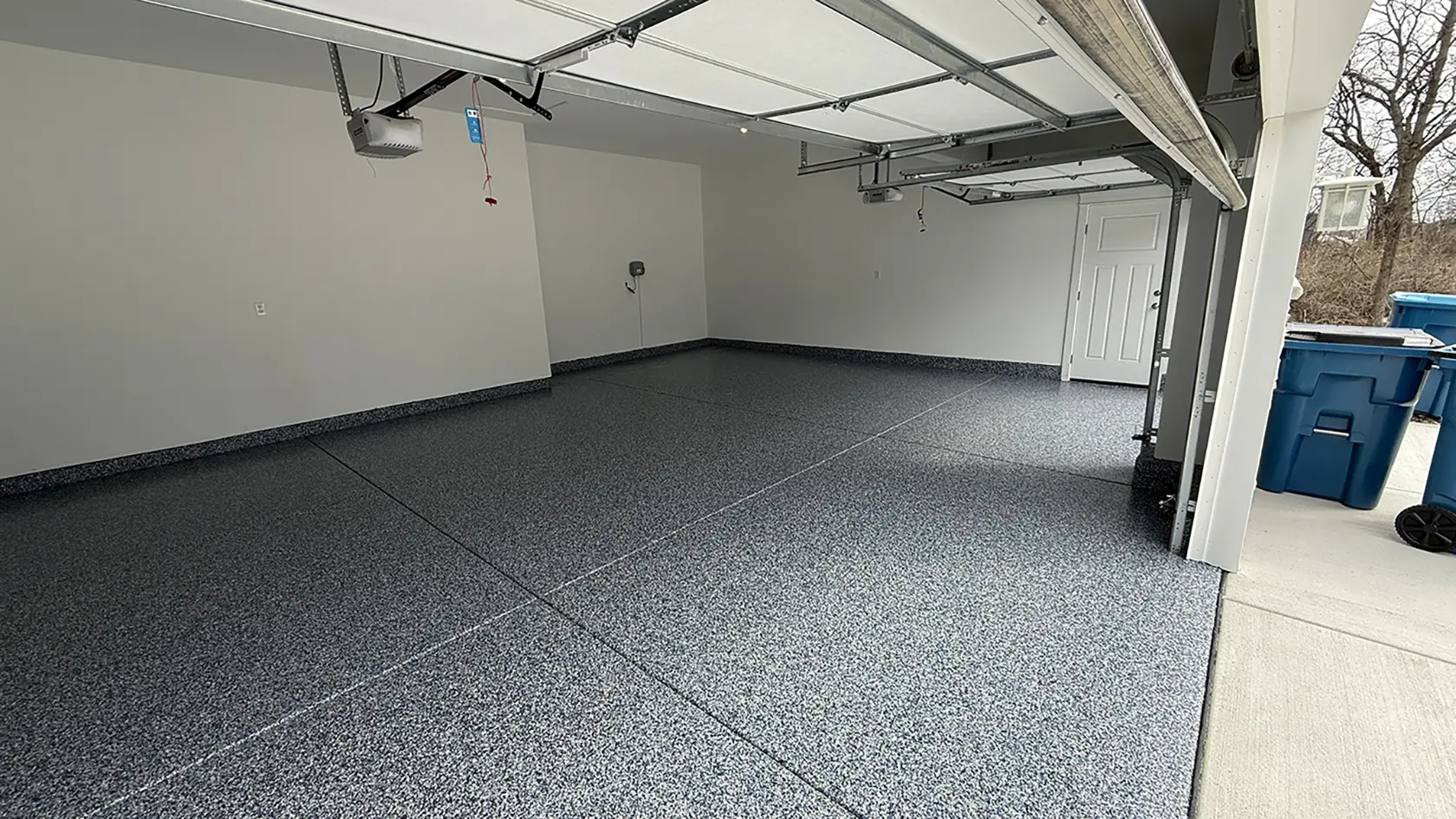
How a Concrete Coating Works

It's a Stack of Layers.
Not a Single Coat.

A real concrete coating isn't paint — it's a bonded stack of layers built over diamond-ground concrete. Here's what each layer does, and why the order and the prep are what make a floor last 15–20 years instead of peeling in one Chicago winter.

Diamond-Ground Prep Polyaspartic Topcoats Written Warranty
(847) 999-6330
★★★★★ 5.0 Google  ·  100+ reviews

Get Your Free Estimate

Same-week on-site visits

No obligation  ·  100% satisfaction

5.0 ★★★★★
100+ Chicago garages reviewed on Google
1,000+ Garages
Coated across Chicago & the suburbs
Licensed & Insured
Illinois-bonded garage floor contractor
Written Warranty
Lifetime on garage installs · 5-yr basement/exterior · 3-yr commercial
The Core Idea

A Coating Is a System, Not a Paint Job

When most people picture a "coated floor," they picture a bucket of paint rolled over concrete. That is not what we do. Every floor we finish is a stack of engineered layers, applied in sequence — each with a specific job, each depending on the layer below it to hold.

Read the stack from the bottom up: your slab is diamond-ground open so resin can bite into it, a resin basecoat bonds down into those pores, an optional flake or quartz layer adds grip and colour, and a polyaspartic topcoat absorbs every hit after that. Pull one layer out and the whole floor fails.

Mechanical bond, not glue Four working layers Sealed, non-porous surface
Why the Stack Matters

Floor Paint vs. a Real Coating

They look similar in the can. What happens on the slab could not be more different.

One thin film

Floor Paint

  • Sits on the surface with nothing to grip
  • No dedicated wear layer to take the abuse
  • Chips at the edges, then peels in sheets
  • Hot tires lift it; salt and oil stain through it
  • Re-coating every year or two
A bonded stack

A Real Coating

  • Resin locks mechanically into ground-open pores
  • A separate topcoat absorbs all the wear
  • Layers cure into one seamless, sealed surface
  • Shrugs off hot tires, salt, oil and UV
  • 10–20+ years before it needs attention
Anatomy of the Stack

What Each Layer Actually Does

Follow the build from the slab up. Each layer has one job — and it only works because of the layer beneath it.

1
The anchor

Diamond-Ground Concrete

A fresh slab is sealed and slick on top, but riddled with microscopic pores underneath. We run a diamond grinder across the whole floor to strip that weak top layer away and open the pores — giving resin a rough, clean, thirsty surface to lock into. Skip this and nothing else in the stack can hold.

Required · mechanical grinding, never acid etch
2
The bond

Primer / Basecoat

The first liquid coat soaks into the ground-open pores and hardens, mechanically keying the whole system to the slab. The resin here sets the floor's personality — epoxy is thick and rigid, polyurea is flexible and fast-curing. On damp slabs we swap in a moisture-mitigating primer first.

Required · epoxy or polyurea resin
3
The look & grip

Flake or Quartz Broadcast

While the basecoat is still wet, we hand-broadcast vinyl flake chips or coloured quartz into it so they stand up and embed. Once cured we scrape and vacuum the loose material. This is what gives the floor its colour, texture and slip resistance — sealed inside the stack, never sitting on top.

Optional · the one decorative layer
4
The wear layer

Polyaspartic / Urethane Topcoat

The clear top layer takes all the abuse so the decorative layer never has to. A quality polyaspartic topcoat shrugs off hot tires, road salt, oil and chemicals, and stays crystal clear instead of ambering in sunlight. It locks the flake or quartz in place and sets the final gloss or matte finish.

Required · the surface you live on
The Chemistry, Briefly

Bonding, Curing & Why Timing Matters

A coating doesn't "dry" like paint — it cures through a chemical reaction that hardens each layer and fuses it to the one below. Hit the windows between coats and the stack becomes one solid, monolithic piece. Miss them and the layers never truly bond.

01 · BOND

Grip, not glue

The basecoat doesn't stick like tape — it flows into the pores opened by diamond grinding and hardens inside them. That mechanical key is why a properly prepped floor can't be peeled off in one piece.

02 · RECOAT WINDOW

Layers fuse in sequence

Each coat has a window where the next one will chemically bond to it. Broadcast flake too late, or topcoat too early or too late, and you get layers sitting on each other instead of fused together.

03 · CURE

Reaction, not evaporation

Polyaspartic cures in hours; epoxy takes longer. Cold, damp Chicago air slows both — so we track slab temperature, not air temperature, and give you real drive-on times at the walkthrough.

When the Stack Breaks

Three Ways a Coating Fails

Almost every peeling, blistering floor we're called to fix traces back to one of these — a layer that was skipped, rushed, or wrong for the job.

1

The grinding was skipped

A "clean," smooth slab still has a sealed surface. Without diamond grinding — or with acid etching subbed in — the resin has nothing to key into, so it sits on top and peels in sheets after the first freeze-thaw cycle. This one step is why pro floors last 15–20 years and DIY kits fail in a winter.

2

Moisture was ignored

Concrete wicks water up from the soil, especially in basements and slab-on-grade garages. If vapor pressure is too high and no mitigating primer goes down, it pushes the coating off — you get bubbles, blisters and white delamination within months. We moisture-test any slab we suspect before resin touches it.

3

The wrong resin was used

Even a perfect install fails if the resin is wrong for the room. Standard epoxy outdoors or in a sunny garage yellows and goes brittle in a season; a cheap topcoat loses gloss and picks up hot-tire marks fast. Matching the resin to how the floor is actually used is half the job.

The failure is almost never the resin itself — it's a shortcut in the stack. Review how the layers work →

We Install Across Chicagoland

Every coating system, every neighborhood. From the city itself out to the far suburbs.

We also travel to select projects in southern Wisconsin and northwest Indiana — contact us to discuss your location.

Questions

How a Coating Works — FAQs

The questions Chicago homeowners ask us most when they want to understand what's actually going onto their floor.

© Concrete Shield Coatings Inc. All rights reserved. | Terms & Conditions | Privacy Policy

Call Now